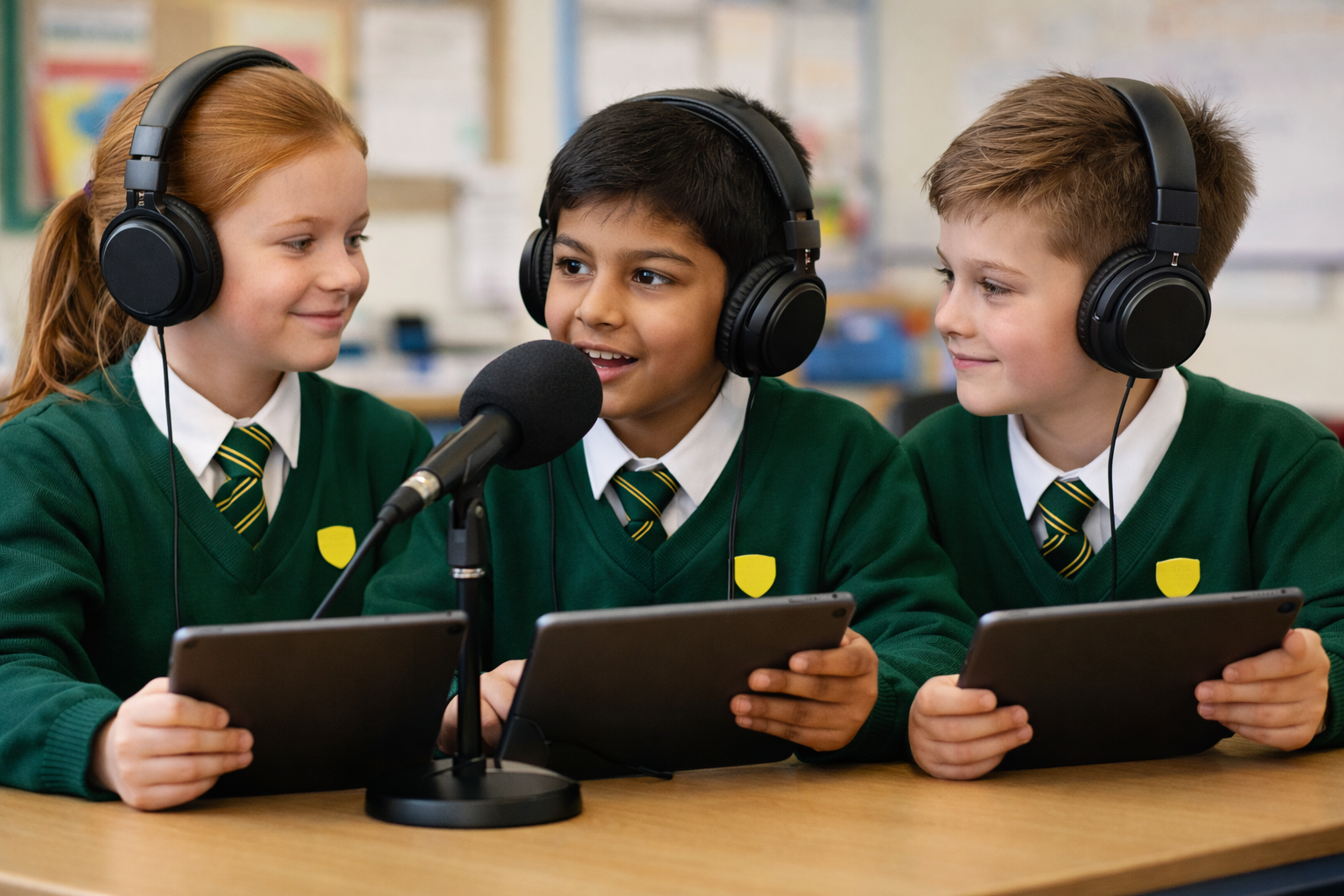




For generations, schools have taught children to read and write. Yet one of the most important skills a child will ever develop — the ability to speak confidently, listen carefully and communicate effectively – has too often been left to chance.
That could be about to change.
On 15 October 2026, Education Secretary Lucy Powell delivered a significant speech at the Confederation of School Trusts (CST) Conference, announcing plans to give oracy equal status to reading and writing within the revised National Curriculum in England.
It is a landmark announcement, and one that could fundamentally change how schools approach spoken language, communication and classroom participation.
For those of us who believe every child deserves to find their voice, it is a hugely welcome development.
What Has the Government Announced?
The Education Secretary confirmed that oracy will become a distinct strand of the English curriculum, alongside reading and writing.
In her speech, Lucy Powell said:
“And I can announce today that I will give oracy equal status to reading and writing, as a new strand of the English curriculum.”
She also confirmed that speaking, listening and communicating would form part of both curriculum content and assessment, from primary education through to GCSE and beyond.
This is an important distinction.
Oracy is not simply being recognised as something beneficial that schools should encourage. The government intends to embed it more formally within what children are taught and how their learning is assessed.
The detailed requirements, assessment arrangements and implementation timetable are still to be established through the curriculum reform process. Nevertheless, the direction is clear: speaking and listening are being placed at the heart of educational reform.
Why Oracy Matters More Than Ever
We are living through a period of extraordinary technological change.
Artificial intelligence can now write essays, summarise information, generate presentations and answer complex questions within seconds.
But technology cannot replace the importance of genuine human connection.
Children still need to explain their thinking, ask thoughtful questions, listen to different perspectives, resolve disagreements and express how they feel.
These are not optional extras. They are fundamental life skills.
The Education Secretary made precisely this connection in her speech, arguing that as AI becomes increasingly influential, schools must place greater emphasis on the human capabilities that technology cannot fully replicate.
Oracy sits at the centre of that ambition.
A child who can communicate confidently is better equipped to participate in lessons, build friendships, contribute to their community and eventually navigate the workplace.
And while reading and writing have long been recognised as essential foundations for educational success, spoken language deserves the same attention.
Making Oracy an Entitlement, Not a Privilege
Perhaps the most important aspect of the announcement is its emphasis on equality.
The Education Secretary acknowledged that confident communication has too often been associated with privilege.
Children arrive at school with very different experiences of language and conversation. Some have had extensive opportunities to discuss ideas, ask questions and explain their opinions. Others may have had fewer opportunities to develop these skills.
Without deliberate teaching, those differences can become embedded.
A confident speaker may naturally volunteer answers, contribute to discussions and attract positive attention. A quieter child, perhaps equally capable, may struggle to demonstrate what they know.
This is why oracy must be taught systematically rather than assumed.
Every child should have the opportunity to become a confident communicator, regardless of their background, additional needs or starting point.
That does not mean expecting every child to become an accomplished public speaker. It means helping children develop the ability to communicate in ways that are appropriate, meaningful and accessible to them.
For some, success might mean speaking confidently in front of a class. For others, it might mean contributing to a small-group discussion, asking for help or expressing a complete sentence for the first time.
Each achievement matters.
What Will This Mean for Primary Schools?
The government’s announcement is particularly significant for primary education.
The foundations of confident communication begin early. From Reception onwards, children develop language through conversation, imaginative play, storytelling, questioning and interaction with others.
Primary schools already undertake a tremendous amount of work in this area. The challenge is ensuring that opportunities to develop oracy are consistent, progressive and available to every child.
As the revised curriculum takes shape, schools may need to consider several important questions:
- How do we teach speaking and listening skills explicitly?
- How can we ensure every child participates?
- What does progress in oracy look like?
- How do we support children with speech, language and communication needs?
- How can teachers assess spoken communication without creating unnecessary workload?
- How do we integrate oracy into existing subjects rather than treating it as another isolated initiative?
The answer should not be to add another substantial burden to an already crowded school day.
Instead, the opportunity is to make high-quality classroom talk a natural part of teaching and learning.
In English, children might explain a character’s motivations or discuss alternative endings to a story.
In science, they might describe an experiment, make a prediction or explain what their results show.
In mathematics, they might justify their reasoning rather than simply provide an answer.
In history, pupils might debate different interpretations of an event.
Oracy can strengthen learning across the entire curriculum.
From Speaking More to Speaking Better
Encouraging children to talk is important, but effective oracy education goes further.
Children need opportunities to develop specific communication skills progressively.
That includes learning how to:
- Organise thoughts into clear sentences.
- Use increasingly ambitious vocabulary.
- Explain ideas and justify opinions.
- Listen actively and respond appropriately.
- Ask meaningful questions.
- Build upon another person’s contribution.
- Speak with confidence in different situations.
- Disagree respectfully and constructively.
These skills require modelling, practice, feedback and repetition.
A child might begin by describing a picture using a simple sentence. Over time, they can learn to develop more detailed explanations, introduce new vocabulary and communicate increasingly complex ideas.
The progression matters.
We would never expect children to become proficient readers without carefully structured teaching. There is no reason to treat spoken communication differently.
Supporting Children with SEND
The government’s speech also placed considerable emphasis on inclusion and improving provision for children with special educational needs and disabilities (SEND).
This is particularly relevant to oracy.
Children develop communication skills in different ways and at different rates. Some may experience speech and language difficulties, while others may find social communication or classroom participation challenging.
An inclusive approach to oracy must recognise these differences.
Visual prompts, structured sentence starters, small-group discussions, adult modelling, additional processing time and carefully adapted activities can all help children participate.
For some pupils, alternative and augmentative communication approaches may also be essential.
What matters is creating an environment where every child’s contribution is valued.
Oracy should never become a measure of who speaks the loudest or most confidently. It should be an opportunity for all children to develop their ability to communicate.
How Oracy Champions Can Help Schools Prepare
At Oracy Champions, we believe communication skills should be developed deliberately, progressively and inclusively.
Our focus is helping primary schools make oracy an accessible and practical part of everyday learning.
Oracy Champions supports teachers in developing children’s spoken language, vocabulary, confidence and communication through structured learning activities.
Rather than treating oracy as an occasional presentation or classroom discussion, the aim is to give children regular opportunities to practise and develop their skills.
1. Building confidence from an early age
Children benefit from opportunities to speak in a supportive environment where mistakes are part of learning.
Structured speaking activities help pupils gain confidence in expressing ideas, responding to questions and contributing to discussions.
2. Developing vocabulary and complete sentences
Being able to communicate effectively depends on having the language to express ideas.
Oracy Champions helps children develop vocabulary and practise constructing sentences, progressing towards richer descriptions and more detailed explanations.
3. Encouraging meaningful classroom discussion
Oracy is not just about speaking. It is equally about listening, understanding and responding.
Activities can encourage children to share their views, consider different perspectives and build confidence when communicating with others.
4. Supporting inclusive participation
Some children require additional scaffolding or individual support to participate fully.
Oracy Champions can support whole-class teaching as well as more targeted, one-to-one activities, including for pupils with additional communication needs.
5. Making oracy manageable for teachers
One of the biggest challenges facing schools is finding time to implement new educational priorities.
Oracy development should complement existing teaching rather than compete with it.
By providing structured activities and a clear focus on communication skills, Oracy Champions aims to make oracy teaching easier to incorporate into everyday classroom practice.
The Importance of Measuring Progress
One of the most interesting elements of the government’s announcement is the intention to include oracy within assessment.
This raises important questions about how spoken language development should be recognised.
Unlike written work, spoken communication can be difficult to capture through conventional assessment methods.
A child’s progress might be demonstrated through increased confidence, more precise vocabulary, longer explanations, better listening or greater willingness to participate.
Schools will need approaches that recognise these different forms of progress without turning every conversation into a formal test.
Assessment should support learning, not discourage children from speaking.
As further curriculum guidance emerges, developing proportionate, inclusive and practical ways to recognise progress in oracy will be an important consideration for teachers and school leaders.
Oracy, Artificial Intelligence and the Future of Education
There is another reason why this announcement feels particularly timely.
As AI becomes more capable, our understanding of what constitutes a valuable education is evolving.
Knowing information remains important. So does being able to read, write and reason effectively.
But children will also need to communicate, collaborate, question information and explain their thinking.
Consider a young person entering the workforce in ten years.
They may use AI to research a problem or generate a first draft of a report. Yet they will still need to discuss their findings with colleagues, question assumptions, negotiate solutions and make decisions.
These are profoundly human activities.
The ability to communicate clearly may become more valuable, not less, in an AI-enabled world.
Education must prepare children not simply to use emerging technologies but to remain confident, thoughtful and capable individuals alongside them.
A Defining Opportunity for School Leaders
For primary headteachers, multi-academy trusts and curriculum leaders, the announcement represents an opportunity to review how spoken language is developed across their schools.
The immediate priority is not to rush into creating additional policies or assessments before the revised curriculum is finalised.
It is to consider whether every child currently receives sufficient opportunities to develop their communication skills.
Are classroom conversations dominated by the most confident pupils?
Do teachers have the resources and confidence to teach oracy explicitly?
Are speaking and listening skills developed progressively across year groups?
Are pupils with additional communication needs appropriately supported?
And, perhaps most importantly, does every child feel that their voice matters?
These questions are worth asking regardless of the timetable for curriculum reform.
Every Child Deserves a Voice
The government’s commitment to give oracy equal status with reading and writing is a significant moment for education in England.
But policy announcements alone do not transform children’s experiences.
Real change happens in classrooms.
It happens when a child who rarely contributes feels confident enough to offer an answer.
It happens when a pupil finds the vocabulary to explain a difficult idea.
It happens when children learn to listen respectfully to someone with a different opinion.
And it happens when teachers recognise that developing spoken language is fundamental to learning, inclusion and personal development.
At Oracy Champions, we welcome this renewed national commitment to speaking and listening.
We believe that every child deserves the opportunity to find their voice, develop their confidence and become an effective communicator.
The challenge now is to turn that ambition into everyday classroom practice.
And that is a challenge worth embracing.
Help Every Child Find Their Voice with Oracy Champions
As England prepares for a greater emphasis on oracy within the National Curriculum, Oracy Champions is here to help primary schools put communication at the heart of learning.
Discover how structured oracy activities can support children’s confidence, vocabulary, speaking and listening skills, whether through whole-class learning or more targeted support.
Explore Oracy Champions: https://oracychampions.com
Source: Department for Education, Education Secretary speech at CST Conference 2026, delivered 15 October 2026.