
Oracy Games
Here are engaging oracy games that incorporate recording voice notes to enhance speaking and listening skills:
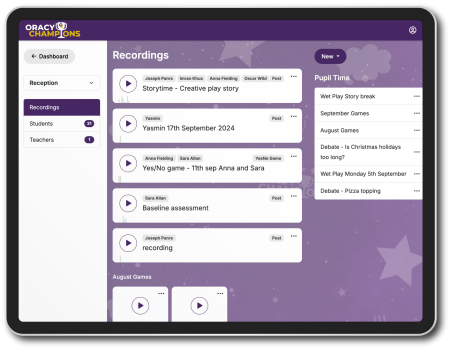
Story Relay
Linguistic, cognitive and social and emotional
Description: One person starts a story with a recorded voice note and sends it to the next participant. Each person adds to the story with their own recording until it reaches the last person.
Objective: Develop creativity and coherence in storytelling while practicing listening and building on others’ ideas.
Audio Diary
Social and emotional
Description: Participants record daily diary entries describing their day, feelings, or thoughts. These can be shared with a partner or a group.
Objective: Improve self-expression and reflective thinking while practising regular speaking.
Mimic the Master
Social and emotional
Description: Participants listen to a recording of a famous speech, poem, or dialogue and then try to mimic the tone, pace, and emotion in their own recording.
Objective: Enhance listening skills, attention to detail, and the ability to convey emotions through speech.
Debate Voice Notes
Cognitive, Linguisic and Physcial (standing up)
Description: Choose a topic for debate. Participants record their arguments and counterarguments in voice notes, sent back and forth.
Objective: Develop persuasive speaking, critical thinking, and the ability to construct and deconstruct arguments.
Character Voices
Linguisic
Description: Participants choose a character (real or fictional) and record a monologue or dialogue as that character.
Objective: Foster creativity, explore different vocal techniques, and practice perspective-taking.
Interview Role-play
Social and emotional
Description: One participant plays the role of an interviewer, and the other plays the interviewee. They record their questions and answers as voice notes.
Objective: Enhance questioning techniques, active listening, and articulate responses.
Instruction Challenge
Cognitive, Linguisic, social and emotional
Description: One participant records a series of instructions (e.g., a simple recipe or how to perform a task). Others listen and try to follow them accurately.
Objective: Develop clear and precise communication skills and attentive listening.
Opinion Poll
Social and emotional
Description: Pose a question or a controversial statement. Participants record their opinions and reasons, which are then shared and discussed.
Objective: Practise forming and expressing opinions, listening to others’ perspectives, and respectful debate.
Dont use Fillers
Cognitive
Give your pupils a recording challenge of 60 seconds straight without using ‘umm, er, you know what I mean, like and so’ Each time a pupil says one of the words they get docked a point from 60. This is a fantastic challenge and really gets pupils thinking about their language.
The Yes/No game
Cognitive and Linguistic
For 60 seconds, try and interview a pupil and try and get them to say yes or no. Think about the question and response. This requires great listening and forward planning.
Pace game
Physical and cognitive
Give each pupil a text that if read at the right speed would be 40 seconds long. See how long each student takes and compare explaining how long it should actually take to read out if read correctly.
Solid arguments
Cognitive, social and emotional and linguistic
- The NHS should be free?
- Everyone should have a pet?
- Pineapple should be on every pizza
- London is the best capital city in the world
- Roald Dahl is the greatest childrens author
Group discussions
social and emotional
If you could only eat one food for the rest of your life what would it be and why?
Pupils need to demonstrare listening and appropriate responses.